Whitefish Lake
Whitefish Lake, Alaska, USA
- Found by MetDetect
- Human-verified · Marc Fries
- No meteorites recovered
- Fireball (UTC)
- 2025-04-24 18:31:04 ± 30 s video
- Observed by
- How it was observed
- Radar searched
- PAHG
- Meteorites
- none recovered
- MetDetect
- MetDetect RUN-42 test set, development result · radar PAHG
How it was observed
- Casual videoTwo fixed security cameras near Anchor Point and two dash cams (a school and a car in Anchorage) filmed it in daylight.Scamfer et al. 2026, Sect. 2.8 (Optical)
- Seismic37 seismic stations recorded the fireball's shock waves.Scamfer et al. 2026 (abstract)
- Infrasound16 single infrasound sensors and four infrasound arrays recorded the sound waves.Scamfer et al. 2026 (abstract)
- WitnessesA few public eyewitness reports were filed (American Meteor Society / IMO event 2280 of 2025).Scamfer et al. 2026, Sect. 2.2 and data statement
Fireball cameras are cameras built to record meteors, usually all-sky and calibrated. Casual video is footage or photos from cameras that were not (dash cams, doorbell and security cameras, phones); where a source does not say what kind of camera, it is listed as video of unknown type. Only what a source documents is listed; a missing label means nothing of that kind is documented, not that it did not exist.
Automated detection
MetDetect searched the PAHG radar around the fireball time. It found the fall: its first pick, the echo it ranks most like falling debris, is the debris identified by hand, and the object grown from it holds 26% of the hand-identified cells.
- 5of the 19 hand-identified cells on PAHG found
- 14hand-identified cells missed
- 0cells reported that were not identified by hand
- 100%of the cells it reports were identified by hand (purity)
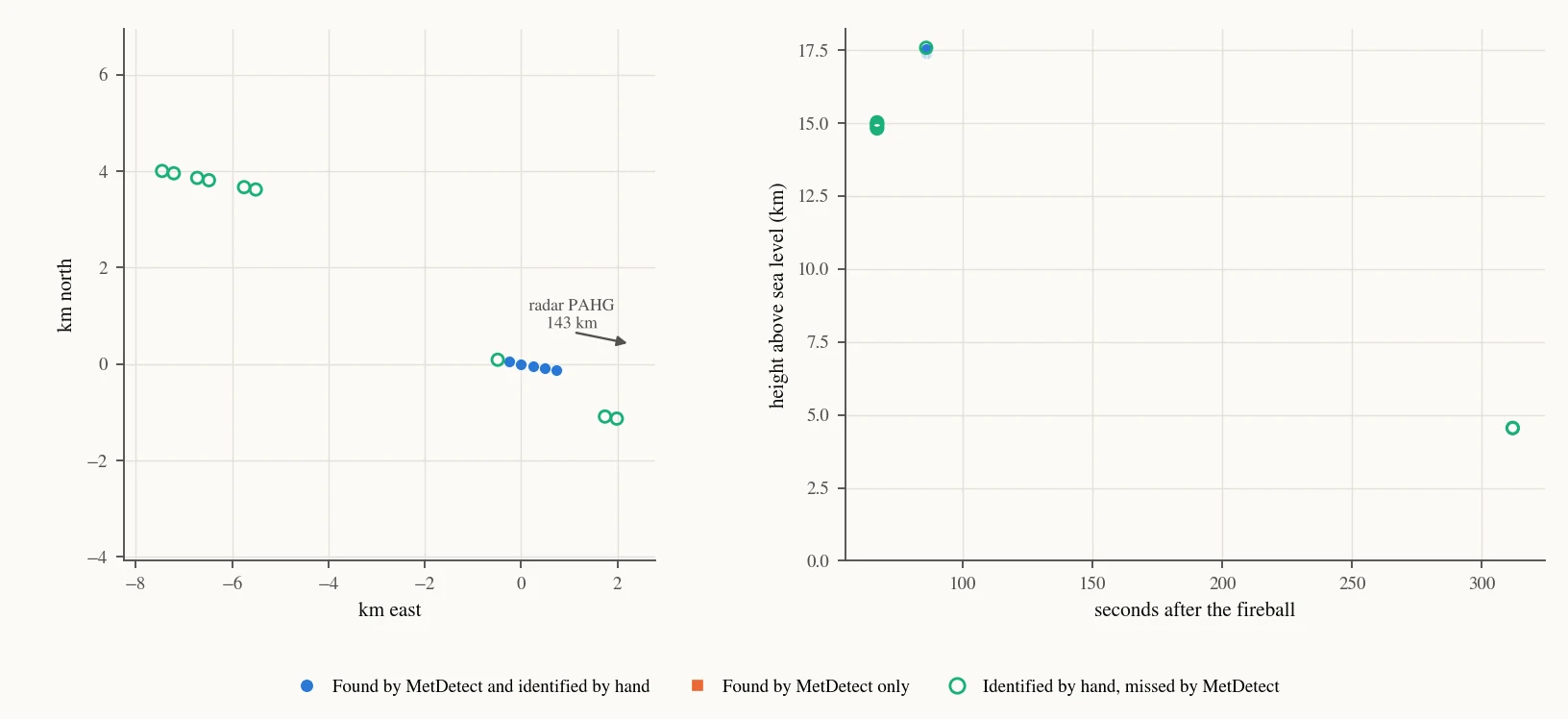
MetDetect RUN-42, 12 Nov 2026. Leave one fall out: every learned part was trained without the fall it is scored on. 30 of the 32 falls are the test set (dual-polarization radar, at least 10 hand-identified radar measurements on the radar searched); the other 2 are used for training only and are not in the headline numbers. The method was developed on these falls, so these are development results, not a blind test. The hand identification is the reference these numbers are graded against.
Dark flight
After the fireball goes dark, meteorites fall freely through the wind. Each radar cell is flown down to the ground through the winds of that day; the coloured areas show where stones of each mass most likely landed, and the black line runs from light to heavy stones (solid where the radar traced it, dashed where extended). The map shows both: (a) from MetDetect's cells on PAHG, (b) from the radar cells identified by hand by Marc Fries on every NEXRAD radar labelled, in the same frame and colour scale. Each panel gives its search area for stones of 10 g and up (the 90% regions) and the recovered stones of 10 g and up inside it. The two search areas overlap by 38% (shared area over combined area).
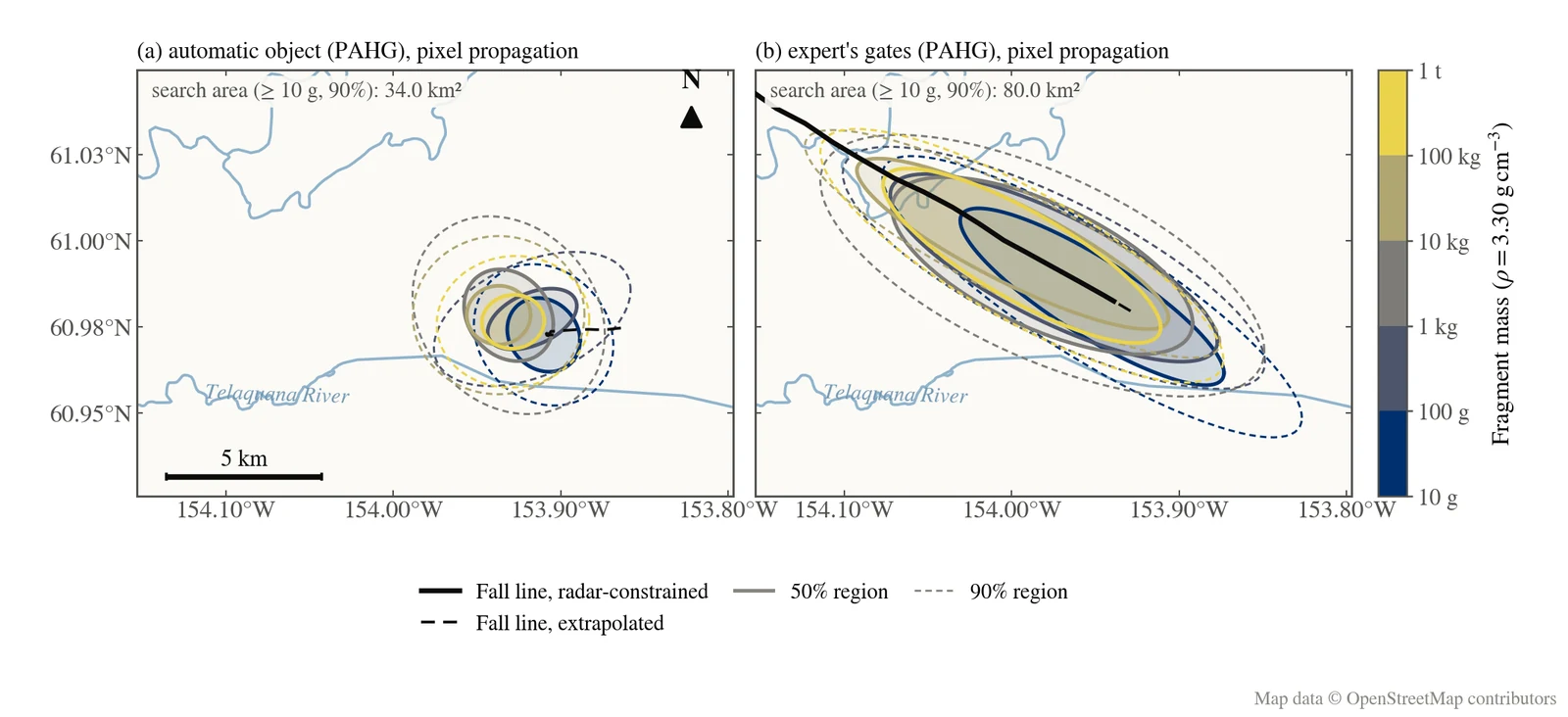
Pixel estimate, computed by P. Shober with MetDetect: winds from ERA5 (ECMWF), masses at the fall's assumed bulk density (on the colour bar). Preliminary: it does not fit the fireball itself, so the heavy end of the line is an extrapolation. Villages and rivers: © OpenStreetMap contributors.
Human identification
The radar signatures of this fall were identified by hand by Marc Fries. Read the original report (archived copy).
The NASA ARES page for this fall was not archived; the link goes to the archived list of events.
Meteorites
No meteorites reported.
Publications
No papers on this fall yet that we know of.
Know of a paper or a recovered meteorite we missed? Tell us.