El Sauz
Starr County, Texas, USA
- Found by MetDetect
- Human-verified · Marc Fries
- Meteorites recovered
- Fireball (UTC)
- 2023-02-15 23:22:41 ± 15 s GOES lightning mapper (GLM)
- Observed by
- How it was observed
- Radar searched
- KBRO
- Meteorites
- El Sauz (L6) Meteoritical Bulletin entry
- MetDetect
- MetDetect RUN-42 test set, development result · radar KBRO
How it was observed
- Casual videoA photo of the fireball was posted online, and a home security camera clip caught the sonic boom, with birds scattering.IMO article (fireball photo); Fox News (home camera boom clip)
- SatelliteTwo US weather satellites (GOES-16 and GOES-18 lightning mappers) recorded a 43-millisecond flash at 23:22:41 UTC.NASA/SETI GLM bolide database, event 63f2b146071e7667e683aef4
- SeismicA magazine article cites good seismic data for the event and shows a seismic record; the station and analysis are not given.Meteorite Times, The Fall and Hunt of the El Sauz Bolide (1 May 2023)
- WitnessesNine people reported it to the American Meteor Society; sonic booms were heard across the Rio Grande Valley.Welzenbach, Fries et al. 2024, LPSC 55 abstract 2678 (AMS event 1036-2023)
Fireball cameras are cameras built to record meteors, usually all-sky and calibrated. Casual video is footage or photos from cameras that were not (dash cams, doorbell and security cameras, phones); where a source does not say what kind of camera, it is listed as video of unknown type. Only what a source documents is listed; a missing label means nothing of that kind is documented, not that it did not exist.
Automated detection
MetDetect searched the KBRO radar around the fireball time. It found the fall: its first pick, the echo it ranks most like falling debris, is the debris identified by hand, and the object grown from it holds 44% of the hand-identified cells.
- 53of the 121 hand-identified cells on KBRO found
- 68hand-identified cells missed
- 0cells reported that were not identified by hand
- 100%of the cells it reports were identified by hand (purity)
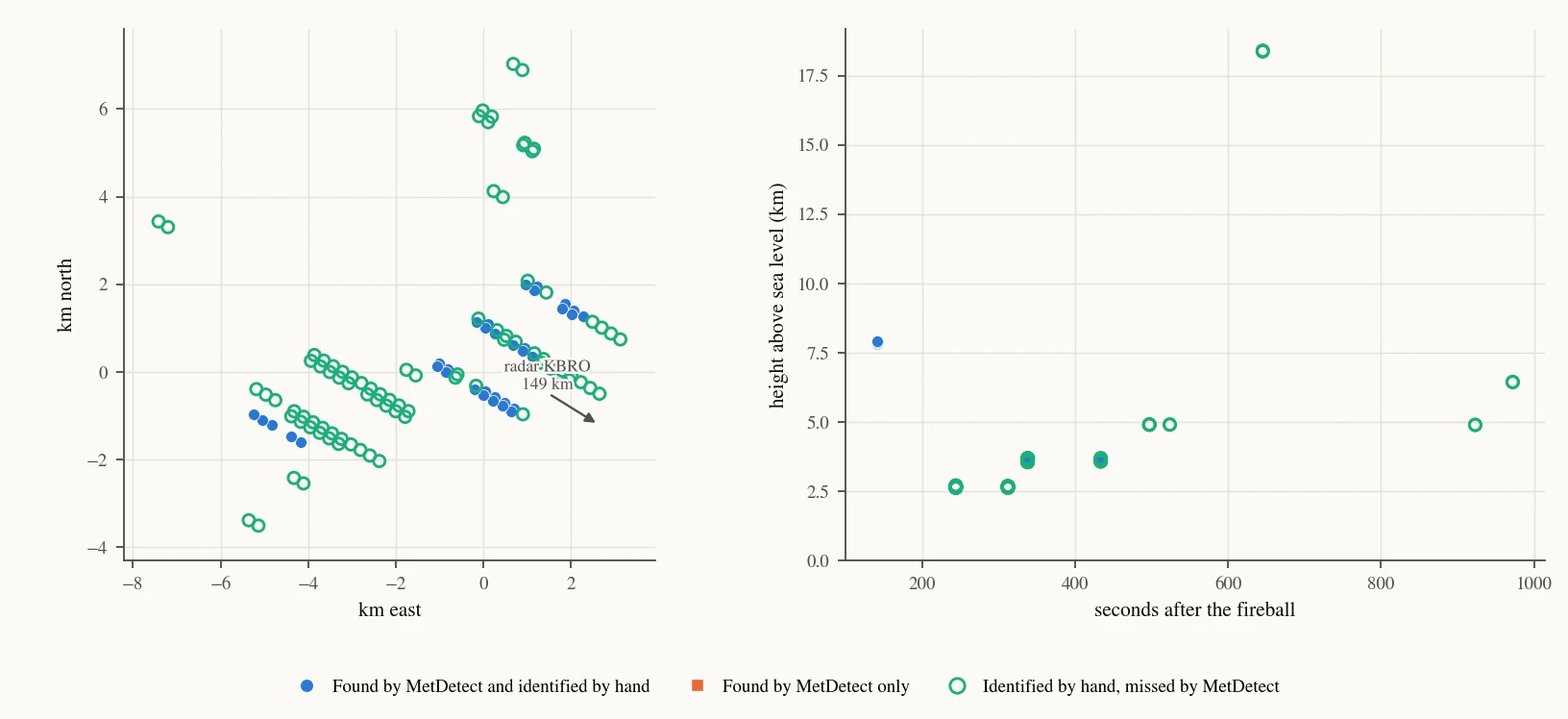
MetDetect RUN-42, 12 Nov 2026. Leave one fall out: every learned part was trained without the fall it is scored on. 30 of the 32 falls are the test set (dual-polarization radar, at least 10 hand-identified radar measurements on the radar searched); the other 2 are used for training only and are not in the headline numbers. The method was developed on these falls, so these are development results, not a blind test. The hand identification is the reference these numbers are graded against.
Dark flight
After the fireball goes dark, meteorites fall freely through the wind. Each radar cell is flown down to the ground through the winds of that day; the coloured areas show where stones of each mass most likely landed, and the black line runs from light to heavy stones (solid where the radar traced it, dashed where extended). The map shows both: (a) from MetDetect's cells on KBRO, (b) from the radar cells identified by hand by Marc Fries on every NEXRAD radar labelled, in the same frame and colour scale. Each panel gives its search area for stones of 10 g and up (the 90% regions) and the recovered stones of 10 g and up inside it. The two search areas overlap by 3% (shared area over combined area).
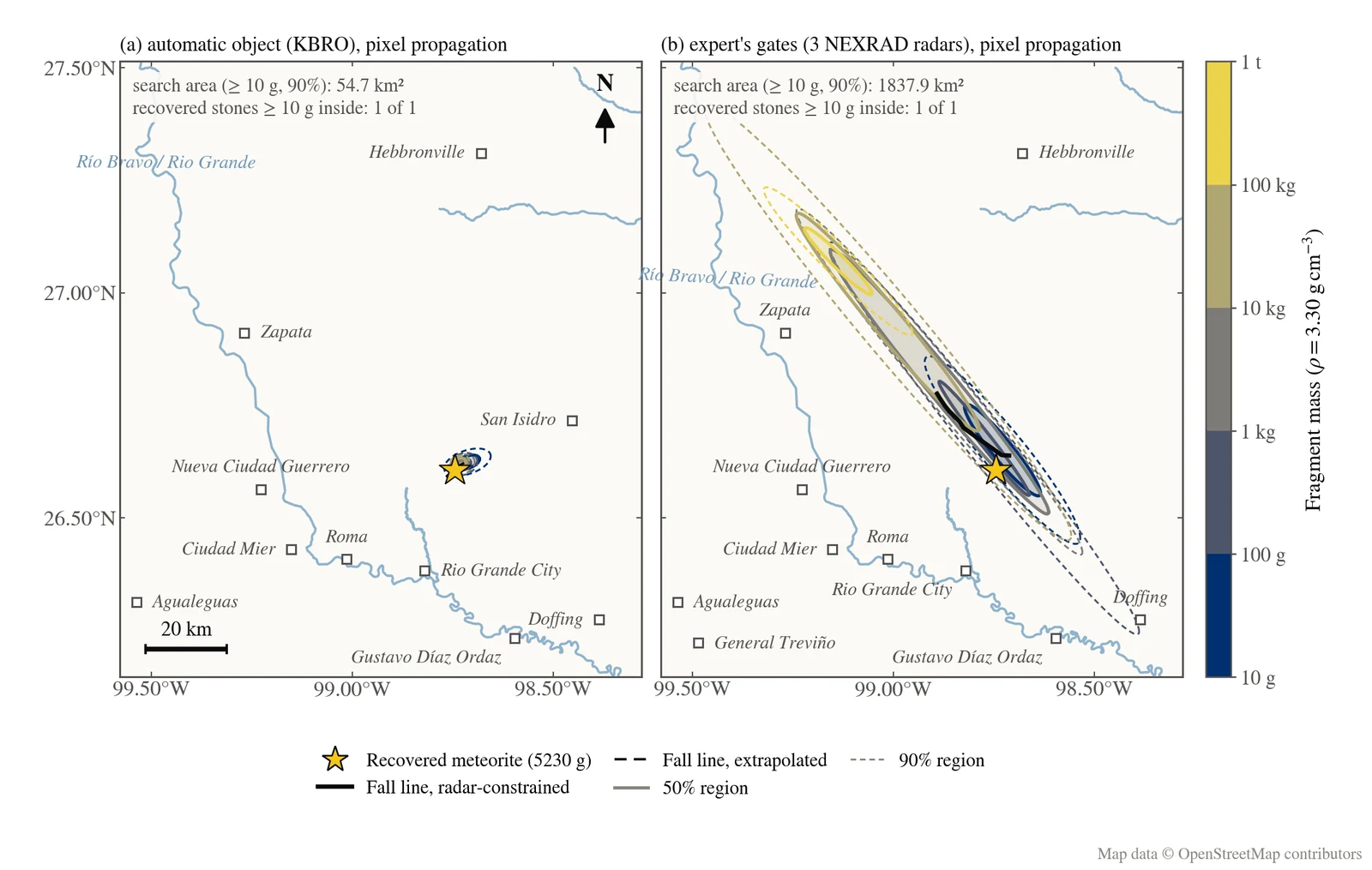
Pixel estimate, computed by P. Shober with MetDetect: winds from ERA5 (ECMWF), masses at the fall's assumed bulk density (on the colour bar). Preliminary: it does not fit the fireball itself, so the heavy end of the line is an extrapolation. The star marks the reported recovery site, since no positions of single stones are published; position from Meteoritical Bulletin 112. They are drawn for comparison only and were never used to make the maps. Villages and rivers: © OpenStreetMap contributors.
Human identification
The radar signatures of this fall were identified by hand by Marc Fries. Read the original report (archived copy).
Meteorites
- El Sauz · L6
Publications
No papers on this fall yet that we know of.
Know of a paper or a recovered meteorite we missed? Tell us.