Sensor fusion & radar meteorite detection
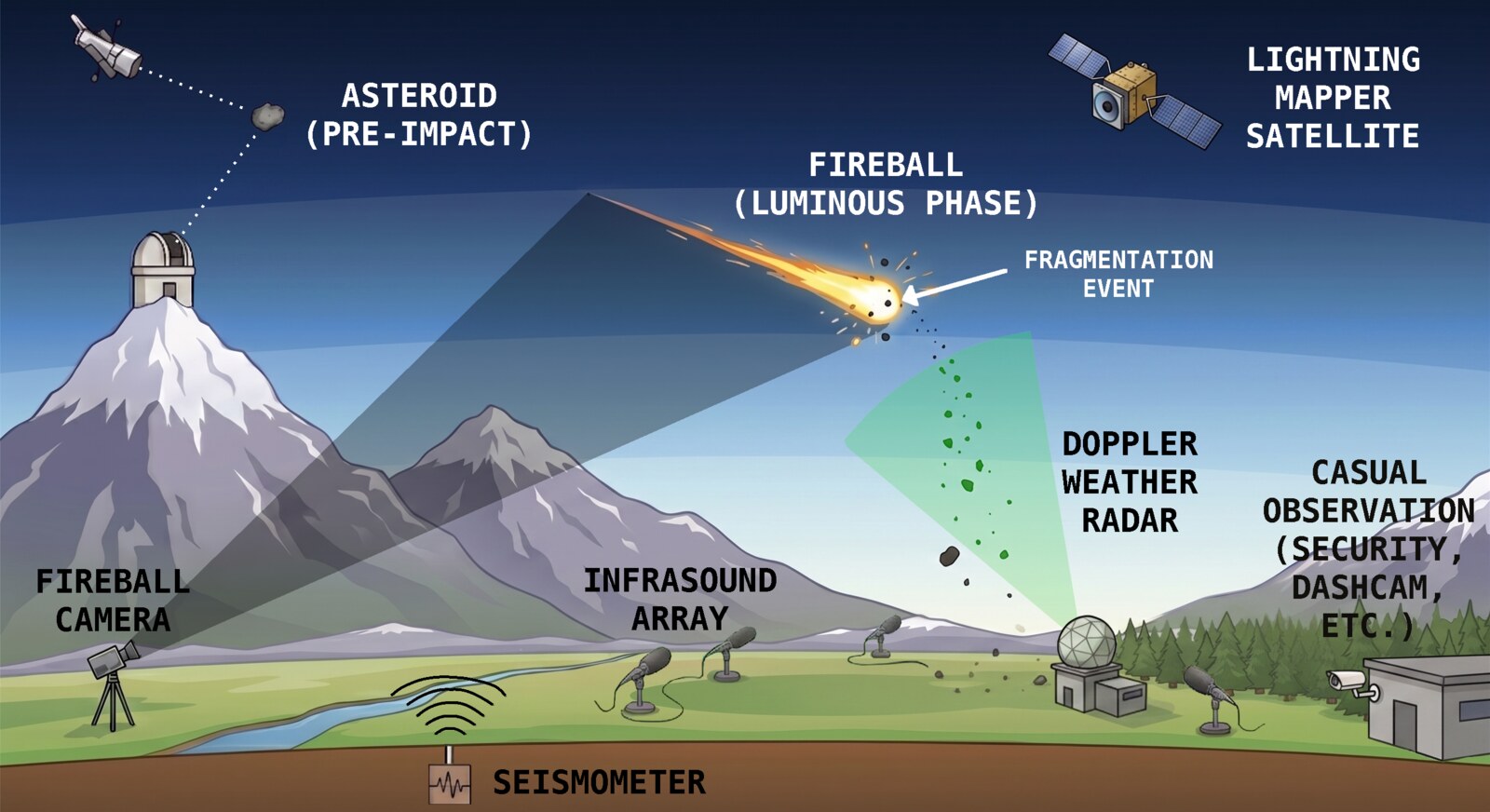
Working toward fusing radar, optical, infrasound and seismic data into one estimate of a falling body, so an event can be followed from the first telescopic detection through to the meteorite on the ground.
MetDetect: meteorites in weather radar
At NASA Johnson Space Center (ARES) I’m building MetDetect, which uses the U.S. NEXRAD (Next-Generation Radar) Doppler weather-radar network, a continent-scale, openly available mesh that can pick up falling meteoritic debris. I work on it with Paul Abell and Mark Fries, who pioneered the Doppler-radar meteorite method, and our aim is to turn that network into an automatic, physically interpretable detector of fresh meteorite falls.
The detector ingests volumetric radar scans, suppresses weather noise, clusters spatio-temporal echoes with unsupervised machine learning, and applies consistency tests (altitude–time slope, fall-consistent apparent velocities, alignment with winds, multi-scan persistence). Candidates get a confidence score, and the strongest are flagged for rapid follow-up. A planned next step is a radar-fall simulator to generate annotated synthetic data, both to train a convolutional neural network for more robust detection and to provide a forward model for parameter inference. Try the interactive in-browser demo — real detected falls in 2D and 3D — and see live ACM 2026 results at /acm2026.
Sensor fusion & sequential estimation
A single sensor only ever sees part of an entry. The real leverage comes from fusing them: optical astrometry and photometry from camera networks, Doppler radar (low-altitude debris, drift and terminal mass), infrasound and seismic records (total energy and fragmentation altitudes), and spectra / radiometry (composition and ablation regime). My research program aims to treat each significant bolide as a multi-sensor inverse problem, combining these heterogeneous streams with sequential Bayesian estimators (Kalman-type filters) that would update the meteoroid’s state (position, velocity, mass, density, fragmentation) and the ablation/fragmentation model parameters as each observation is assimilated.
The output should be full posterior distributions for pre-atmospheric mass, bulk density, strength and fragment size-frequency, rather than single best-fit values, with the uncertainties carried through to the predicted fall ellipse. Coupling the forward model to hierarchical Markov-chain Monte Carlo (MCMC) would let constraints be inferred jointly across events.
Closing the decametric gap
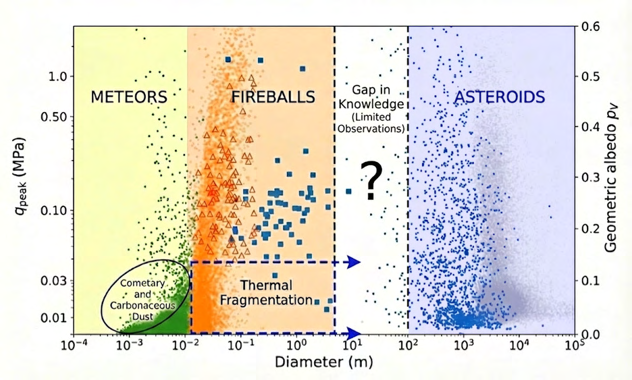
The 10–100 m size range is the worst-characterized in the whole small-body inventory: telescopic surveys become inefficient for objects this small and dark, while fireball networks only sample what actually hits Earth. Yet this regime dominates the impact flux responsible for Chelyabinsk-type events and probes the transition between rubble-pile asteroids and individual meteoroids, a core planetary-defense concern. Tying the multi-sensor bolide constraints to the decametric NEO population that upcoming infrared surveys will reveal (NEO Surveyor, NEOMIR) is the path to closing this gap.
From discovery to recovery
A small but growing number of asteroids have now been spotted before impact, among them 2023 CX1, which dropped meteorites over Normandy. What I want is routine full-chain, “telescope-to-ground” events: telescopic discovery and spectroscopy → predicted trajectory and impact energy → luminous flight in the camera networks → fragmentation from infrasound/seismic → dark flight in Doppler radar → prediction and recovery of the meteorites, with every step fused into one coherent, uncertainty-aware estimate. Building that pipeline, and helping prepare networks like FRIPON for it, is what my sensor-fusion work is for.