Cometary ↔ asteroidal reservoir mixing
Most “comet-like” fireballs aren't produced by cometary material at all. Long-term integrations show the near-Earth “Jupiter-family” population is dominated by asteroidal interlopers.
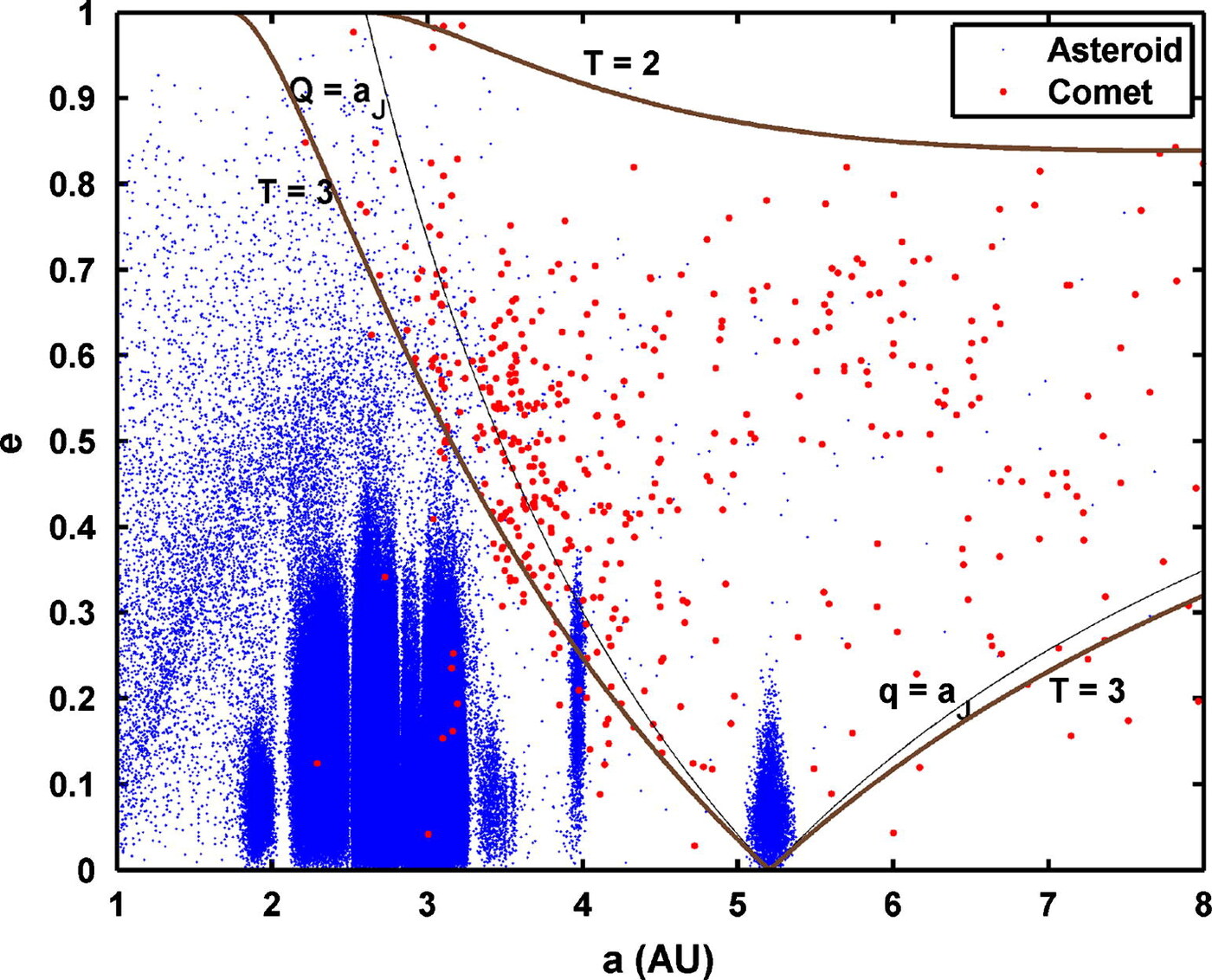
The mixing problem
How does volatile-rich material from the outer reservoirs blend with more refractory, inner-solar-system material in near-Earth space? That mixing controls the composition gradient of the young solar system and the delivery of water and organics to the terrestrial planets. In the classical picture, Jupiter-family comets (JFCs) arrive from the Kuiper belt and scattered disk on chaotic, low-inclination orbits with a Tisserand parameter between 2 and 3, while near-Earth asteroids are fed from the main belt through resonances and evolve more regularly.
What the fireballs actually show
During my PhD I used observed close encounters to quantify this mixing, first analyzing the longest well-observed grazing fireball on record, in which an Apollo-type asteroidal meteoroid was scattered by Earth onto a JFC-type orbit. That motivated an observationally anchored steady-state model of Earth close encounters: a small but persistent flux (~2.5 × 10⁸ objects yr⁻¹, ~0.1% of the population in this size range) is transferred from asteroidal orbits (Tisserand parameter above 3) onto JFC-type orbits.
In my thesis’s final paper, long-term integrations of 50 sporadic DFN fireballs on JFC-type orbits found that fewer than 4% are genetically cometary; the rest behave as stable asteroidal bodies. During my postdoc in Paris I scaled this up, comparing 646 well-observed “JFC-like” fireballs from French, Australian, Czech and American sensors against 661 cataloged JFCs, and confirmed it: 79–92% of the meteoroids on “JFC-like” orbits show no sign of frequent Jupiter encounters, and only 1–5% of all the fireballs those four networks detected are dynamically cometary — while roughly 22% of near-Earth JFCs (16 of 72) actually follow stable, asteroid-like orbits.
Simple proxies like the Tisserand parameter are not enough at these sizes: dynamical stability diagnostics are essential to separate the reservoirs. Genuinely cometary material is too friable to survive long in near-Earth space, so little of it ever reaches the ground. I’m now finalizing a study of >2,200 “asteroids on cometary orbits” (in preparation), combining long-term integrations, unsupervised clustering and physical properties (albedo, taxonomy) to map the mixing interface more finely.