Perihelion filtering & the meteorite record
Meteorite collections aren't a fair sample of what hits Earth. What survives to the ground is decided by an object's history close to the Sun, not only where it came from.
The carbonaceous paradox
Dark, primitive, water- and organic-rich carbonaceous bodies dominate the small-body reservoirs and, by debiased impact-flux models, should supply at least half of the macroscopic objects striking Earth. Yet only about 4% of recovered meteorites are carbonaceous chondrites. These same materials also have the shortest cosmic-ray exposure ages of any meteorite class, meaning they were broken off their parent bodies recently, after those parents were already on near-Earth orbits.
If carbonaceous meteoroids are released so recently and so close to home, do we see coherent streams of them? Testing meteorites, instrumented fireballs and space-based impact detections, I found no significant excess clustering, only a modest signal in telescopic NEO catalogs, consistent with short-lived families from recent tidal disruption. That null is expected rather than informative, though: streams decohere in 10⁴–10⁵ yr, which is fast enough to erase the clustering before we could see it. So the streams tell us nothing either way, and the paradox stands where it was — high expected flux, recent production, and only ~4% of recovered meteorites carbonaceous.
A two-step filter near the Sun
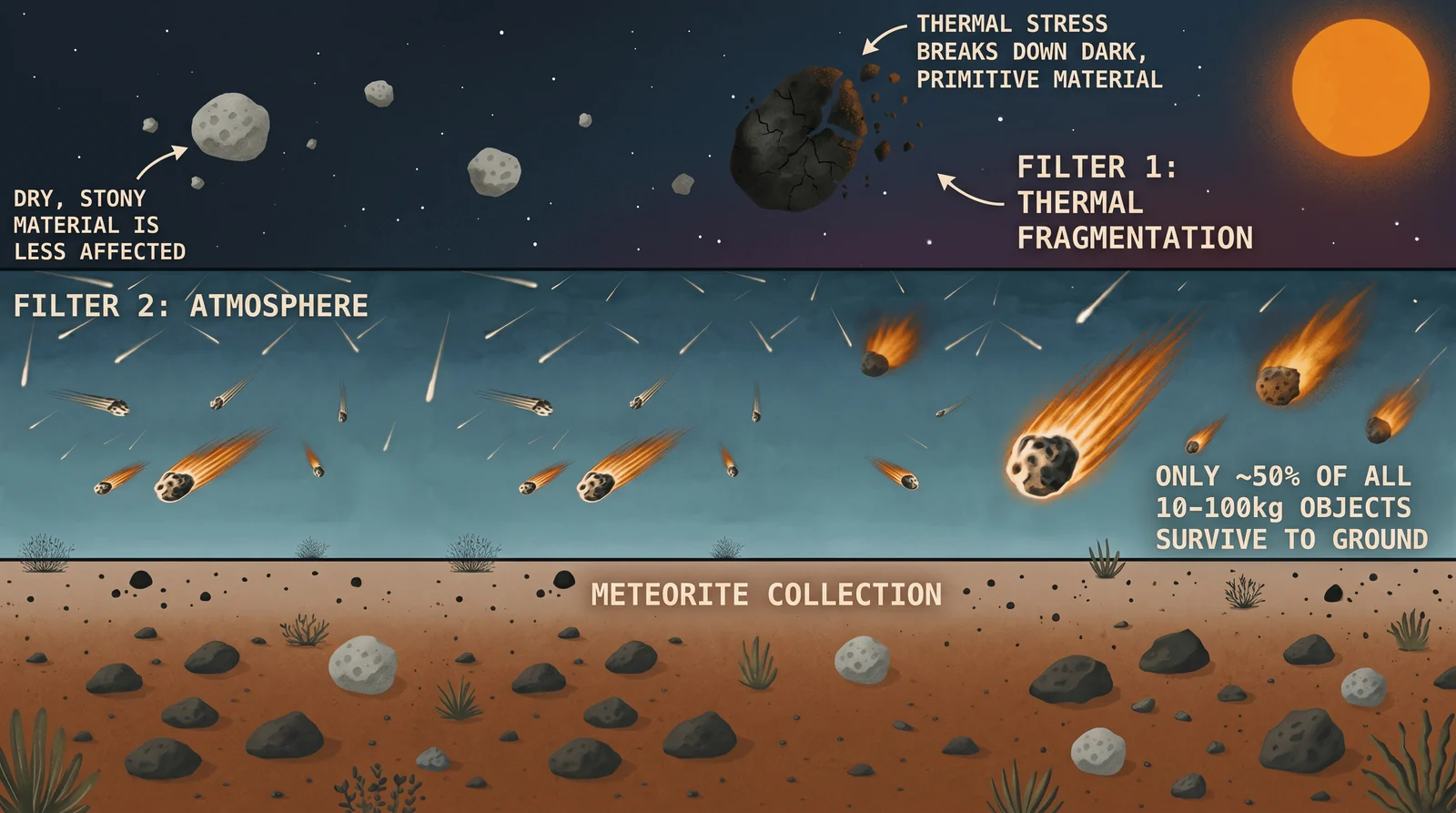
To test whether the atmosphere preferentially destroys this weak material, I led a synthesis of decades of data from 19 fireball networks across 39 countries (a debiased top-of-atmosphere sample of nearly 8,000 meteors above 10 g and more than 500 likely meteorite-droppers), published in Nature Astronomy.
After correcting for observational bias, the population of falls is not simply explained by source regions delivering intrinsically weak bodies. Instead, perihelion-distance history is the single best predictor of survival: objects that have spent time at low perihelion are systematically depleted among the falls, and the survivors come disproportionately from low-inclination, low-perihelion orbits (excesses up to ~11×). The natural reading is a two-step filter: repeated cycles of heating and cooling at small perihelion distances fracture friable, hydrated material, and atmospheric entry then removes the remaining porous fragments. Meteorite collections are thus enriched in compact survivors and depleted in fragile primitive matter. That picture is consistent with the rubble-pile structure and thermal-fatigue cracking seen on carbonaceous asteroids, and with the carbonaceous impactor fragments found in Chang’e-6 lunar samples.
Where it’s going
I want to push this further. Upcoming infrared surveys will be key: NASA’s NEO Surveyor will be especially sensitive to the dark, low-albedo asteroids this filter implicates, and I’d like to use its data to test thermal fatigue near the Sun as the driver of carbonaceous fragmentation, which feeds models of how water and organics are delivered to the inner solar system.
In the press: American Scientist, “Unrepresentative Meteorites”; The Conversation; and the Academic Minute, “The Case of the Missing Meteorites.”