Meteorite recovery & fireball networks
Turning fireball-camera data into trajectories and orbits, and helping ground teams find the meteorites that follow.
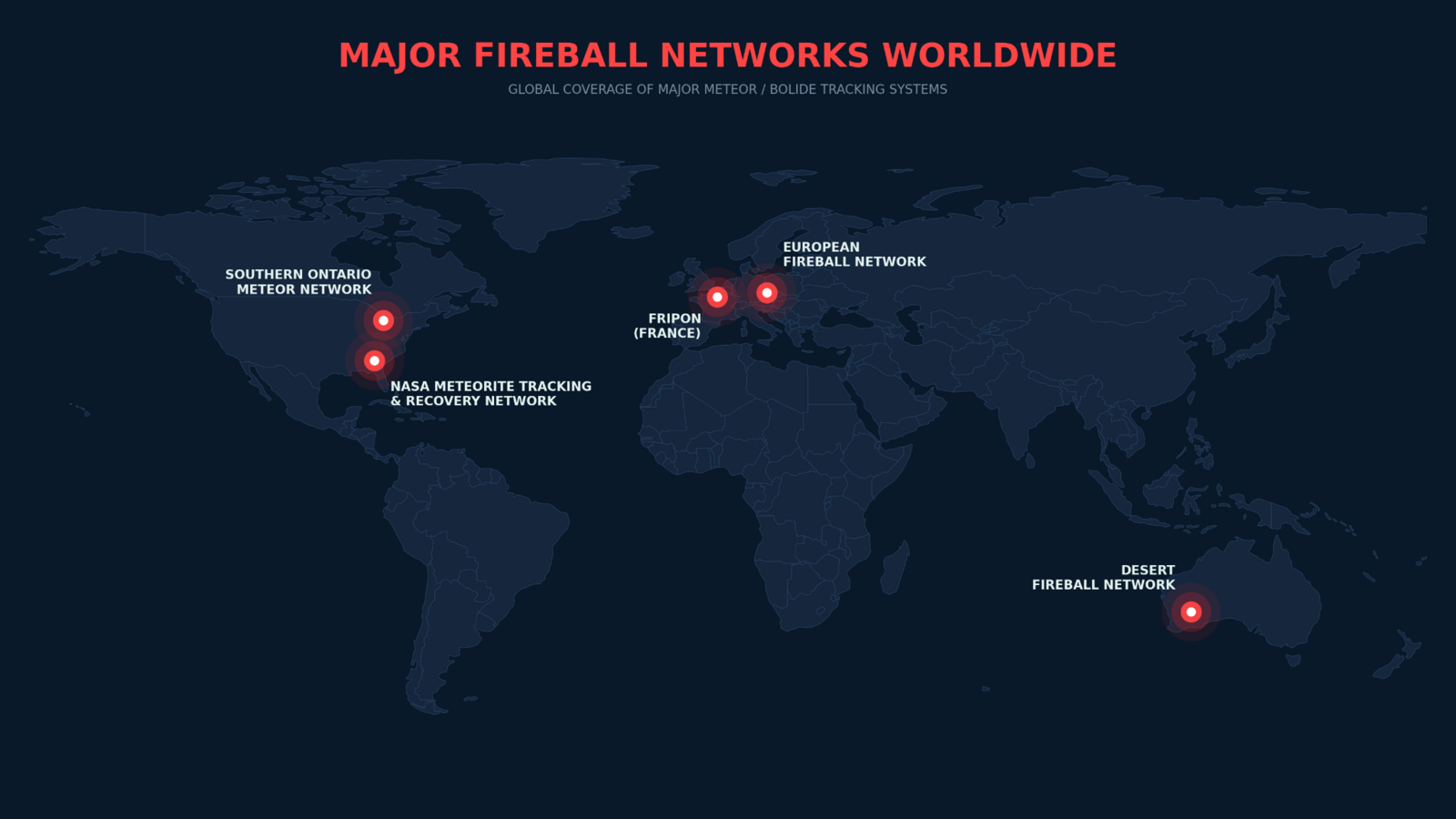
I work on the data-reduction and analysis side of three wide-field fireball networks: the Desert Fireball Network (DFN, during my PhD), the Global Fireball Observatory (GFO), and FRIPON, where I have been part of the scientific core team since 2022. That work runs from multi-station astrometry and photometry through trajectories, orbits and dark-flight modeling, and includes the fall-line predictions that ground search teams use to decide where to look.
I also led a systematic comparison of the FRIPON, DFN, WMPL and AMOS reduction pipelines on a common Geminid sample (Shober et al. 2026, A&A), and have contributed to drone- and machine-learning-assisted search methods, often in coordination with citizen-science partners such as Vigie-Ciel.
Recovered meteorites
Falls whose recovery or characterization I contributed to in the literature:
- Arpu Kuilpu (H5), traced to the outer main belt. Shober et al. 2022, MAPS
- Madura Cave, an Australian fall with reconstructed trajectory and orbital history. Devillepoix, Sansom, Shober et al. 2022, MAPS
- Winchcombe (CM2), a rapidly recovered, pristine carbonaceous fall. King et al. 2022, Science Advances · McMullan et al. 2024, MAPS
- Saint-Pierre-le-Viger, meteorites dropped over Normandy by asteroid 2023 CX1, one of the few objects detected before impact. Egal et al. 2025, Nature Astronomy
- Ménétréol, a rapid recovery with pristine analysis (in review). Anderson, Anghel, Shober et al., MAPS
- Puli Ilkaringuru (H5), a Nullarbor fall recovered by the Desert Fireball Network. Meteoritical Bulletin
- Kybo-Lintos, the first meteorite recovered using a drone and a machine-learning search. Anderson et al. 2022, ApJL